

A law firm can win a case and still lose the client.
Strange? Not really, this is the expected result when law firms ignore their client experience.
In 2026, clients expect more than legal expertise. They expect fast communication, smooth onboarding, transparency, and an experience that feels organized from beginning to end.
And when those expectations are not met, clients quietly disappear.
How Does The Client Experience Affect Law Firms?
Here’s the uncomfortable truth: most law firms are not losing clients because of bad legal work.
They are losing them because of poor communication, weak legal intake processes, inconsistent follow-up, and operational friction happening behind the scenes.
The worst part?
Many firms do not even realize it is happening.
This exact issue will be front and center at Stafi’s upcoming Mastermind on June 25. Raquel Gomes (CEO of Stafi) and Renata Musial (VP of Stafi) will join fellow legal leaders to discuss the common points of friction in the client journey and practical ways to eliminate them without creating more internal chaos.
Because growth is not only about getting more leads.
It is about keeping the trust of the ones you already have.
Where Law Firms Lose Clients Without Realizing It
If you want to stop losing clients, start looking for friction in five places.
1. Intake delays: How quickly are inquiries answered?
2. Communication breakdowns: Do clients know what is happening?
3. Expectation gaps: Are timelines and billing clear?
4. Relationship dependency: Does trust sit with one lawyer or the firm?
5. Post-case silence: Are former clients still part of your ecosystem?
Here’s the truth:
Most client loss is preventable. The challenge is identifying the friction before clients quietly leave.
The Silent Killer: Poor Communication
Let’s start with the biggest issue.
Communication.
According to legal industry research, 68% of clients switch law firms because of poor communication, while 41% specifically blame unresponsive staff. That means the majority of client churn is tied not to legal outcomes, but to the client experience itself.
Think about that for a moment.
A client may trust your expertise.
But if they feel ignored?
If emails go unanswered?
If they have no idea what is happening with their case?
Trust starts breaking down.
And once trust disappears, retention becomes almost impossible.
Here’s where many firms go wrong:
They assume silence equals confidence.
Clients see silence as uncertainty.
Today’s legal clients expect proactive updates, quick answers, and clarity. Even when there is “nothing new,” reassurance still matters. Research shows clients increasingly value fast communication, transparency, and digital responsiveness from their legal providers.
The takeaway?
Modern law firm client communication is no longer a bonus. It’s the expectation.
Weak Intake Is Costing Firms More Than They Think
Now let’s talk about the problem many firms underestimate:
Here’s the reality:
You can spend thousands on marketing and referrals only to lose the lead before the first consultation happens.
Research consistently shows that response speed dramatically affects conversion rates.
In fact, law firms that respond to inquiries within five minutes see 400% higher conversion rates than firms responding after 30 minutes or more. Some studies suggest the advantage is even stronger, showing a 9x conversion lift when leads are contacted during the first five minutes.
| Response Time | % of Law Firms | Conversion Impact |
|---|---|---|
Under 5 minutes | 25% | 400% higher conversion |
Under 10 minutes | 33% | Strong conversion advantage |
Under 1 hour | 56% | Moderate advantage |
2+ hours | 39% | Significant conversion loss |
No response | 26% | Total loss |
The message is clear.
Speed matters, and every delayed callback creates friction.
The client who contacted your firm is likely contacting several others.
The first firm that communicates clearly and confidently often wins.
Billing Surprises Destroy Trust Faster Than Firms Realize
Here’s another hidden client killer:
Unexpected invoices.
No client likes surprises, especially financial ones.
Yet many firms still struggle with billing transparency.
When expectations are unclear, trust suffers.
A client who receives a much larger bill than expected often does not complain immediately.
Instead, they quietly decide never to return.
This is where expectation management becomes critical.
Firms that explain billing clearly, define timelines honestly, and proactively discuss costs tend to create stronger long-term loyalty.
Why? Because predictability builds trust, and trust builds retention.
The “One Attorney Relationship” Problem
Many firms unintentionally create a risky dependency:
The client relationship lives with one attorney. Not the firm.
You have probably seen it before.
A client only speaks to one person, only trusts one person, only knows one person.
So what happens if that attorney leaves? The relationship leaves too.
This creates massive vulnerability for growing firms.
Clients should feel connected to the institution, not only one lawyer.

That means creating consistent communication systems, introducing multiple touchpoints, and making sure clients experience the firm as a team.
Scalability depends on repeatability, and repeatability requires systems.
The Follow-up Gap Nobody Talks About
Here’s something surprising:
Many law firms disappear after the case ends.
No check-in, no thank-you, no follow-up.
No relationship nurturing.
And that is a missed opportunity.
Former clients are one of the strongest sources of referrals and repeat business. But relationships fade quickly without touchpoints.
Even a simple post-case communication strategy can improve loyalty:
- A follow-up email after resolution
- Helpful legal updates relevant to the client
- Check-ins at meaningful intervals
- A request for feedback or referrals
Small touches create long-term trust. And long-term trust drives sustainable growth.
Outdated Technology Is Creating Invisible Friction
Now let’s address the elephant in the room.
Technology.
Or more accurately: Outdated systems.
Many firms still operate with fragmented intake systems, missed calls, disconnected communications tools, and manual follow-up processes.
The result? Internal confusion becomes external friction.
Clients feel it. Documents take too long, updates feel inconsistent, messages get lost, or different team members seem out of sync. Rarely is it one major mistake that damages trust; more often, it is the accumulation of small frustrations that makes the experience feel disorganized.
At the same time, client expectations continue to rise. Modern clients increasingly expect fast communication, transparency, clear timelines, and digital experiences throughout the legal process.
This does not mean firms need to remove the human element. In fact, the firms growing fastest in 2026 are combining technology with stronger operational systems to create a smoother client experience.
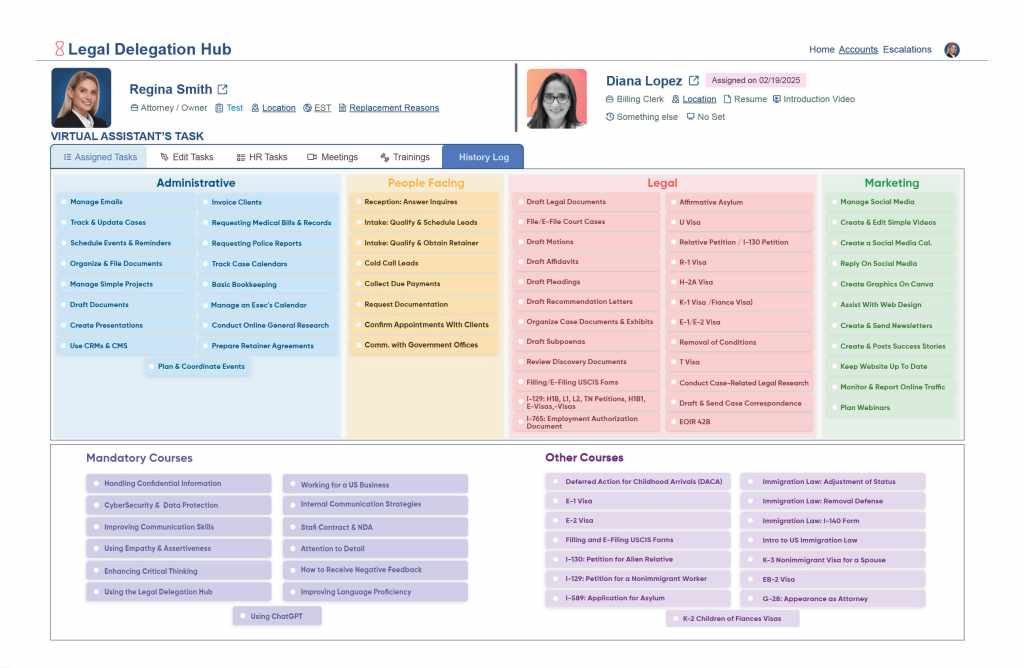
That is where centralized platforms such as Stafi’s Legal Delegation Hub (LDH) are becoming valuable.
Designed to make remote legal staffing easier to manage, LDH gives firms a more centralized way to coordinate legal support, streamline delegation, and improve visibility across workflows, helping reduce operational friction without creating more internal chaos.
The goal is not more technology for the sake of technology. It is building systems that keep teams aligned, improve responsiveness, and create a more consistent experience for clients.
Why Client Experience is Now a Growth Strategy
Law firms are entering a new era: one where legal expertise alone is no longer enough to drive sustainable growth.
The firms growing fastest are not simply the ones winning cases. They are the ones creating a better client experience: responding faster, communicating clearly, and running operations that feel organized instead of reactive.
Clients notice friction. They notice delayed callbacks, inconsistent updates, intake bottlenecks, and overwhelmed teams. And while none of those issues seem catastrophic on their own, together they quietly damage trust.
That is why conversations around law firm efficiency matter more than ever.
Fixing friction is not about asking attorneys to work longer hours.
It is about building the right support systems so lawyers can focus on legal work while operations run smoothly in the background.
Intake needs attention. Follow-up needs consistency. Administrative work piles up. Case management becomes harder to oversee as volume grows.
By providing remote legal staff, intake specialists, paralegals, executive assistants, and 24/7 intake support, Stafi helps firms reduce operational bottlenecks that often lead to missed opportunities and poor client experiences.
The goal is simple: help attorneys spend less time buried in admin work and more time focused on clients, strategy, and billable work.
The firms that improve responsiveness and reduce internal friction will not simply adapt to 2026.
They will be the ones leading it.
If you’re ready to lead the industry, schedule a call or call our 24/7 line (786) 891-5619.